Can accelerated molecular dynamics capture Switch II pocket opening in KRAS G12D without an inhibitor present? Can it also estimate how common those conformations are?
We set out to answer these questions using eight independent 250 ns Gaussian accelerated molecular dynamics (GaMD) simulations of the KRAS G12D structure (PDB ID: 6GOF) bound to GNP, a GTP analogue. The analogue was used to model a GTP-like active state.
We observed Switch II opening and pocket formation in three of eight replicas, providing candidate structures for further study. However, variability among replicas, sensitivity to the opening threshold, and unstable statistical correction prevented a reliable estimate of the equilibrium population.
Capturing the Open State of KRAS G12D
KRAS regulates cell-growth signaling by cycling between GTP-bound and GDP-bound states. The G12D mutation impairs GTP hydrolysis, keeping KRAS active and promoting uncontrolled cell growth in cancer. MRTX1133 is an experimental, noncovalent KRAS G12D inhibitor; its phase 1/2 clinical trial was terminated before phase 2 because of formulation challenges. Preclinical work demonstrated that MRTX1133 can inhibit KRAS G12D through a pocket that becomes transiently accessible as Switch II moves. Hallin et al., 2022.
That pocket is already established, and earlier enhanced-sampling studies have explored cryptic pockets in KRAS G12D. Our aim was to test a practical GaMD workflow: find open-state candidate structures, compare independent simulations, and assess whether the data support a population estimate. Vithani et al., 2024.
We chose GaMD because it accelerates conformational sampling without requiring predefined coordinates for Switch II opening. It is an enhanced-sampling method that adds a boost to the potential energy, making it easier to cross energy barriers between states. This can help a protein explore conformations that ordinary MD would take too long to sample. However, it also changes how frequently those conformations appear, so raw frame counts require statistical correction before they can describe equilibrium populations. Miao et al., 2015.
How we defined pocket opening
The eight replicas produced 2 μs of aggregate simulation. We analyzed 7,773 frames sampled at intervals of approximately 0.25 ns after discarding the first 5 ns of each replica as equilibration.
We used the MRTX1133-bound KRAS G12D structure PDB ID: 7RPZ as a reference snapshot. The position of MRTX1133 in this structure defined where we looked for an open pocket, while its Switch II conformation provided the structural reference for the open state. Each simulation frame had to pass two checks:
- Space: The pocket had to open enough to create a threshold volume near the MRTX1133 binding site.
- Shape: Switch II had to resemble the inhibitor-bound reference shape more closely than its compact starting shape.
Both checks had to pass. The volume measures available space in a reference binding region; it does not establish a connected cavity or show that a ligand can enter and bind.
Because 7RPZ is GDP-bound, whereas our simulated structure contains a GTP analogue, we used it only as a geometric reference for the pocket and Switch II conformation.
Switch II Movement Expands the Pocket
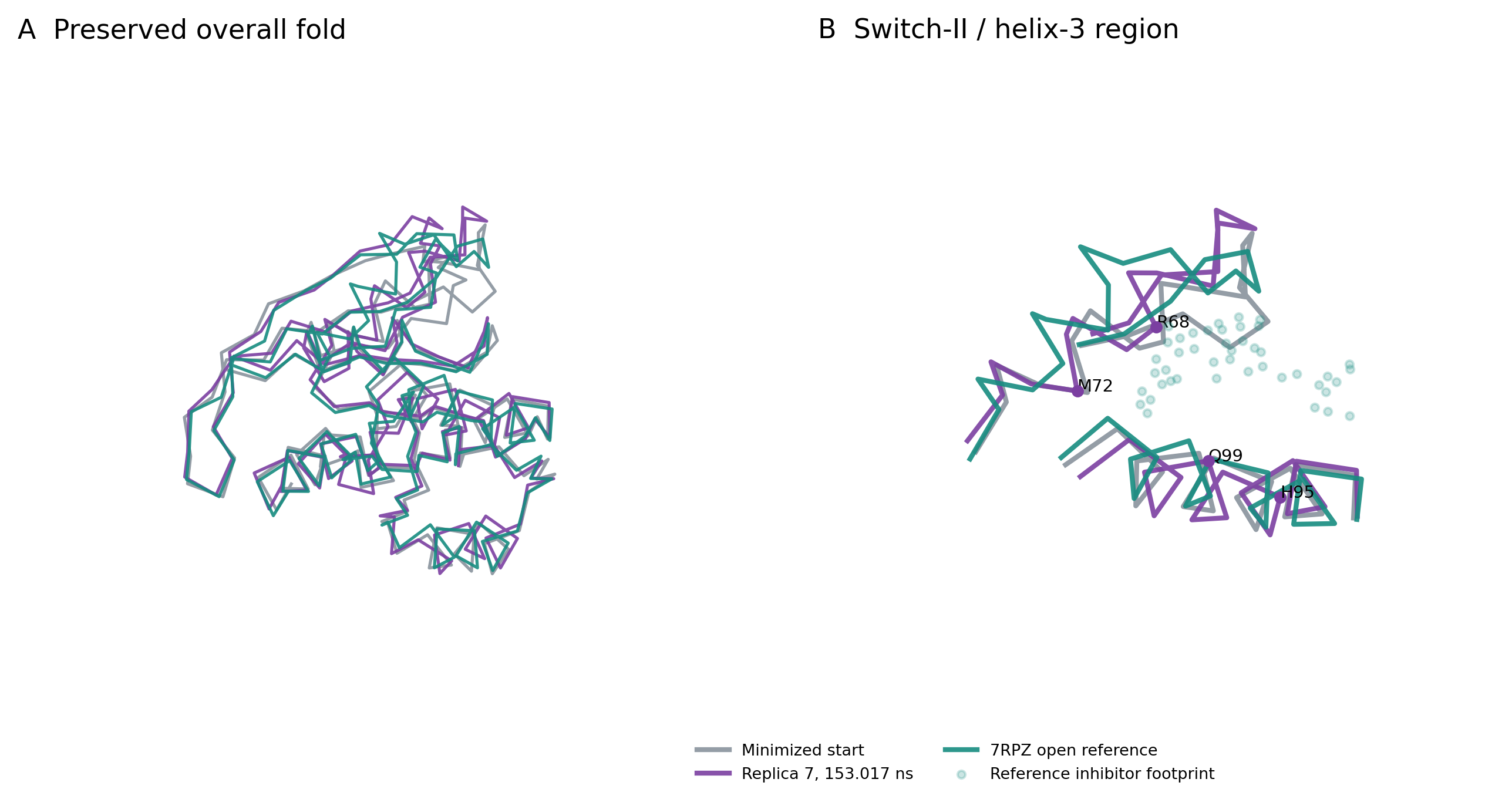
Figure 1 compares a selected snapshot from replica 7 with the reference structure. It shows an outward movement of Switch II and increased probe-accessible space in the predefined MRTX1133 binding region. The opening-like candidate frame has 325.7 ų of accessible volume, compared with 106.7 ų in the compact starting conformation.
View full-size figure
Open larger view · View static comparison
What the other replicas showed
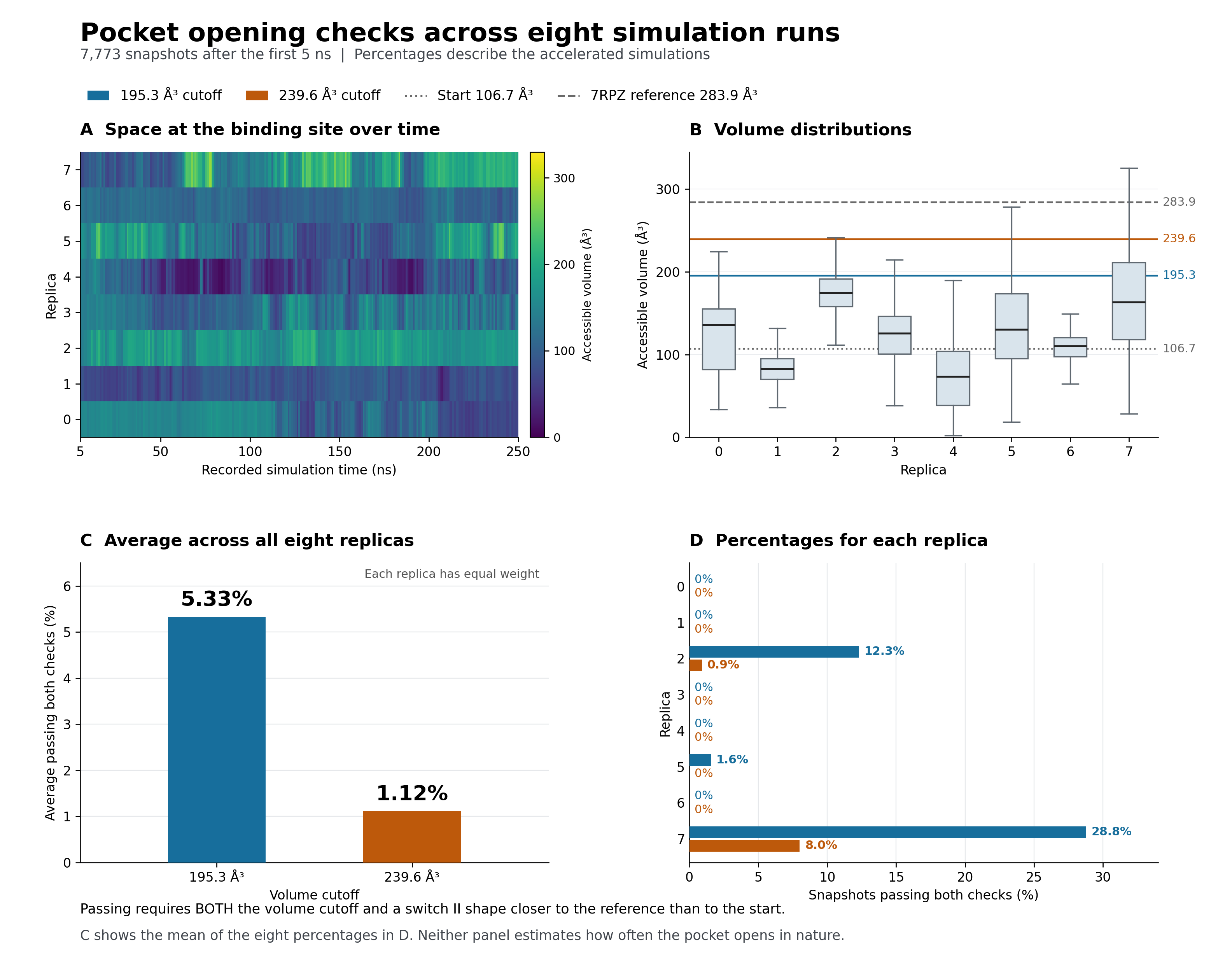
We calculated the percentage of frames in each GaMD replica that passed both opening checks using an initial volume cutoff of 195.3 ų (Figure 2B). The passing fractions were 12.3%, 1.6%, and 28.8% for replicas 2, 5, and 7, respectively (Figure 2D). The other five replicas had no passing frames.
Giving each replica equal weight, the mean passing fraction was 5.33% at the less strict 195.3 ų volume threshold (Figure 2C).
We then used a stricter definition of an open pocket, increasing the minimum required space to 239.6 ų while keeping the shape check unchanged. Only replicas 2 and 7 contained passing frames, with fractions of 0.9% and 8.0%, respectively. Giving each replica equal weight, the mean fell to 1.12%. This shows how sensitive the analysis is to the chosen threshold.
View figure PDF · Download plotted percentages
Correcting for the GaMD Boost
Counting raw GaMD frames tells us whether a conformation was sampled, but not how often it would occur at equilibrium without the GaMD bias. GaMD makes conformational changes easier by raising the bottoms of low-energy wells. Lower-energy conformations generally receive larger boosts, become easier to leave, and appear less often relative to other conformations. The fraction of GaMD frames in a conformation is therefore biased.
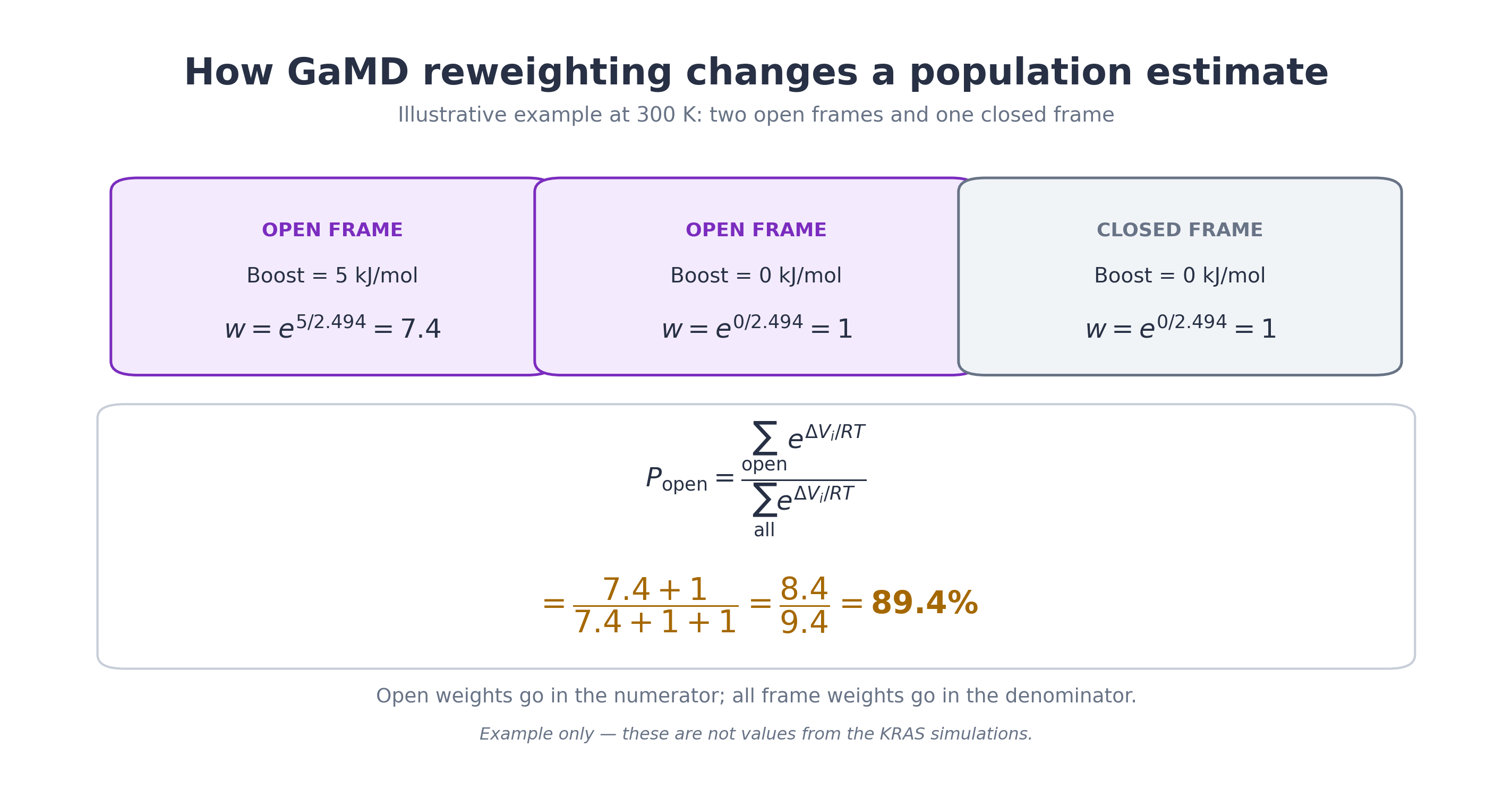
Reweighting corrects for this bias. A frame’s direct correction is proportional to exp(ΔV/RT), where ΔV is its boost energy and RT is the thermal energy per mole. For example, at 300 K, a frame with a 5 kJ/mol boost contributes about 7.4 times more to a population estimate than a frame with no boost.
What the Gaussian comparison tells us
Because the correction grows exponentially with the boost, rare, low-energy frames with large boosts can receive enormous weights. GaMD is designed to keep the boost distribution narrow and approximately Gaussian, or bell-shaped. When that condition holds within each structural group, the correction can be approximated from the mean and variance of its boost values. This is called a second-order cumulant approximation. Miao et al., 2015. In our simulations, however, a small number of high-boost frames created a long right-hand tail and received most of the weight. With too few independent examples to show that these frames were representative, the corrected population could not be estimated with confidence.
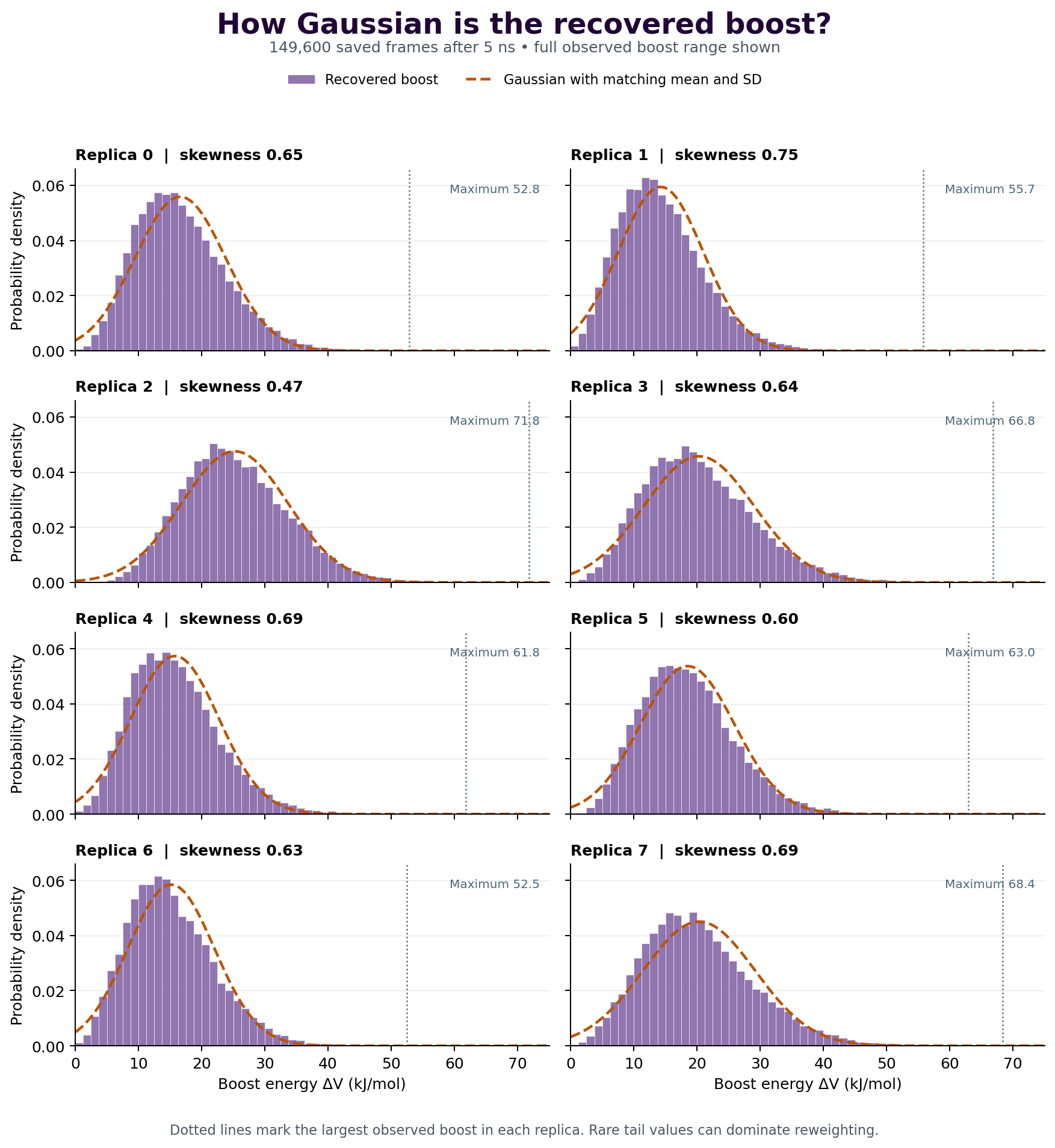
We reconstructed boost energies for all 149,600 saved frames after the first 5 ns. Figure 3 compares the observed values with Gaussian curves. All eight replicas were right-skewed, with skewness of 0.47–0.75: their distributions had longer tails toward large boosts. Those rare tail values receive the largest corrections.
View full-size figure · View figure PDF
Why the correction was unreliable here
Consider replica 4. We normalized each frame’s weight by the sum of the weights across all 17,500 post-equilibration frames. One frame, which failed the opening screen, received a boost of 61.8 kJ/mol and accounted for 83.7% of the normalized weight; the other 17,499 frames shared the remaining 16.3%. Without that single frame, the replica’s reweighted population estimate would have changed substantially.
The key distinction
The weighting formula may be correct, while the population estimate is still unreliable. A correction factor cannot replace observations from important regions that were sampled only once or missed entirely.
Weight concentration reduced the effective sample size to 1.4–20.4 per replica. In terms of weight concentration alone, the thousands of saved frames were equivalent to only about 1–20 equally weighted observations. Correlations between nearby frames would reduce the independent information further.
The right-skewed distributions in Figure 3 do not by themselves invalidate direct reweighting, but they make the Gaussian approximation less secure. Because a few frames dominated the calculation and the replicas disagreed, we could not reliably estimate how often the pocket is open at equilibrium.
What researchers can use now
The pocket candidates are already useful as starting structures for cavity analysis, ensemble docking, and unbiased simulations. Researchers can test whether the pocket is connected, solvent-accessible, well packed, and stable without the GaMD boost. The candidates should not yet be treated as evidence of a stable, frequently populated, or ligand-binding pocket. Estimating the equilibrium population would require longer independent simulations with GaMD parameters chosen to produce a narrower boost distribution, adequate sampling of high-weight regions, and consistent results across replicas.
Study scope. This exploratory case study uses an isolated KRAS domain with a GTP analogue, without a membrane or matched conventional-MD control. Recorded temperatures averaged about 303.1 K against a 300 K target. The historical execution environment and nucleotide parameter provenance were not fully recovered. These limitations constrain biological interpretation and exact reproduction.
Planning a molecular simulation study?
Discuss your scientific question, simulation design and analysis with SimAtomic.
Discuss a StudyReferences
- Hallin J, et al. (2022). Anti-tumor efficacy of a potent and selective non-covalent KRAS G12D inhibitor. Nature Medicine 28, 2171–2182. Read paper.
- Vithani N, et al. (2024). Exploration of Cryptic Pockets Using Enhanced Sampling Along Normal Modes: A Case Study of KRAS G12D. Journal of Chemical Information and Modeling 64, 8258–8273. Read paper.
- Miao Y, Feher VA, McCammon JA (2015). Gaussian Accelerated Molecular Dynamics: Unconstrained Enhanced Sampling and Free Energy Calculation. Journal of Chemical Theory and Computation 11, 3584–3595. Read paper.
- ClinicalTrials.gov. NCT05737706: Study of MRTX1133 in patients with advanced solid tumors harboring a KRAS G12D mutation.
- RCSB Protein Data Bank. 6GOF: KRAS full-length G12D bound to GPPNHP.
- RCSB Protein Data Bank. 7RPZ: KRAS G12D in complex with MRTX-1133.